The Array Adaptive Map Interface. More...
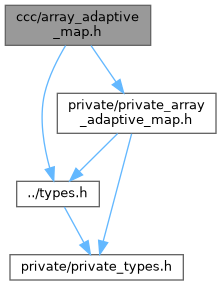
Go to the source code of this file.
Detailed Description
The Array Adaptive Map Interface.
A array adaptive map is a contiguously stored map offering storage and retrieval by key. Because the data structure is self-optimizing it is not a suitable map in a realtime environment where strict runtime bounds are needed. Also, searching the map is not a const thread-safe operation as indicated by the function signatures. The map is optimized upon every new search in attempt to adapt to the usage pattern. In many cases the self-optimizing structure of the map may be beneficial when considering non-uniform access patterns. In the best case, repeated searches of the same value yield an O(1) access and many other frequently searched values will remain close to the root of the map.
The array version of the adaptive map promises contiguous storage and random access if needed with handles. Handles remain valid until an element is removed even if other elements are inserted, other elements are removed, or resizing occurs. All elements in the map track their relationships to one another via indices in the array. Therefore, this data structure can be relocated, copied, serialized, or written to disk and all internal data structure references will remain valid. Insertion may invoke an O(N) operation if resizing occurs. Finally, if allocation is prohibited upon initialization, and the user provides a capacity of C upon initialization, one slot will be used for a sentinel node. The user available capacity is C - 1.
All interface functions accept void * references to either the key or the full type the user is storing in the map. Therefore, it is important for the user to be aware if they are passing a reference to the key or the full type depending on the function requirements.
To use the map as a set, when only keys are needed, wrap a type in a struct or union. For example a set of int could be represented by creating a type struct My_int {int key;};. All interface functions can then be used normally.
To shorten names in the interface, define the following preprocessor directive at the top of your file.
All types and functions can then be written without the CCC_ prefix.
Initialization Interface | |
Initialize the container with memory, callbacks, and permissions. | |
| #define | CCC_array_adaptive_map_storage_for( user_type_compound_literal_array, optional_storage_specifier...) |
| Provides the fixed size type layout and underlying storage for a fixed size map. Helpful if the size in bytes of the underlying storage block is needed. | |
| #define | CCC_array_adaptive_map_default( type_name, type_key_field, comparator...) |
| Initializes the map at runtime or compile time. | |
| #define | CCC_array_adaptive_map_for( type_name, type_key_field, comparator, capacity, memory_pointer) |
| Initializes the map at runtime or compile time. | |
| #define | CCC_array_adaptive_map_from( type_key_field, comparator, allocator, optional_capacity, type_compound_literal_array...) |
| Initialize a dynamic map at runtime from an initializer list. | |
| #define | CCC_array_adaptive_map_with_capacity( type_name, type_key_field, comparator, allocator, capacity) |
| Initialize a dynamic map at runtime with at least the specified capacity. | |
| #define | CCC_array_adaptive_map_with_storage( type_key_field, comparator, compound_literal, optional_storage_specifier...) |
| Initialize a fixed map at compile or runtime from any user chosen type with no allocation permission or context. | |
| #define | CCC_array_adaptive_map_with_allocator_storage( key_field, comparator, allocator, compound_literal) |
| CCC_Result | CCC_array_adaptive_map_copy (CCC_Array_adaptive_map *destination, CCC_Array_adaptive_map const *source, CCC_Allocator const *allocator) |
| Copy the map at source to destination. | |
| CCC_Result | CCC_array_adaptive_map_reserve (CCC_Array_adaptive_map *map, size_t to_add, CCC_Allocator const *allocator) |
| Reserves space for at least to_add more elements. | |
Membership Interface | |
Test membership or obtain references to stored user types directly. | |
| #define | CCC_array_adaptive_map_as(map_pointer, type_name, array_index...) CCC_private_array_adaptive_map_as(map_pointer, type_name, array_index) |
| Returns a reference to the user type in the table at the handle. | |
| void * | CCC_array_adaptive_map_at (CCC_Array_adaptive_map const *map, CCC_Handle_index index) |
| Returns a reference to the user data at the provided handle. | |
| CCC_Tribool | CCC_array_adaptive_map_contains (CCC_Array_adaptive_map *map, void const *key) |
| Searches the map for the presence of key. | |
| CCC_Handle_index | CCC_array_adaptive_map_get_key_value (CCC_Array_adaptive_map *map, void const *key) |
| Returns a reference into the map at handle key. | |
Handle Interface | |
Obtain and operate on container handles for efficient queries when non-trivial control flow is needed. | |
| #define | CCC_array_adaptive_map_swap_handle_wrap( map_pointer, type_output_pointer, allocator_pointer...) |
| Invariantly inserts the key value type. | |
| #define | CCC_array_adaptive_map_try_insert_wrap( map_pointer, type_pointer, allocator_pointer...) |
| Attempts to insert the key value type. | |
| #define | CCC_array_adaptive_map_try_insert_with( map_pointer, key, allocator_pointer, type_compound_literal...) |
| lazily insert type_compound_literal into the map at key if key is absent. | |
| #define | CCC_array_adaptive_map_insert_or_assign_wrap( map_pointer, type_pointer, allocator_pointer...) |
| Invariantly inserts or overwrites a user struct into the map. | |
| #define | CCC_array_adaptive_map_insert_or_assign_with( map_pointer, key, allocator_pointer, type_compound_literal...) |
| Inserts a new key value pair or overwrites the existing handle. | |
| #define | CCC_array_adaptive_map_remove_key_value_wrap( map_pointer, type_output_pointer) |
| Removes the key value in the map storing the old value, if present, in the struct containing type_output provided by the user. | |
| #define | CCC_array_adaptive_map_handle_wrap(handle_pointer, key_pointer) |
| Obtains a handle for the provided key in the map for future use. | |
| #define | CCC_array_adaptive_map_and_modify_with( handle_pointer, closure_parameter, closure_over_closure_parameter...) |
| Modify an Occupied handle with a closure over user type T. | |
| #define | CCC_array_adaptive_map_or_insert_with( handle_pointer, allocator_pointer, type_compound_literal...) |
| Lazily insert the desired key value into the handle if it is Vacant. | |
| #define | CCC_array_adaptive_map_insert_handle_with( handle_pointer, allocator_pointer, type_compound_literal...) |
| Write the contents of the compound literal type_compound_literal to a node. | |
| #define | CCC_array_adaptive_map_remove_handle_wrap(handle_pointer) |
| Remove the handle from the map if Occupied. | |
| CCC_Handle | CCC_array_adaptive_map_swap_handle (CCC_Array_adaptive_map *map, void *type_output, CCC_Allocator const *allocator) |
| Invariantly inserts the key value type. | |
| CCC_Handle | CCC_array_adaptive_map_try_insert (CCC_Array_adaptive_map *map, void const *type, CCC_Allocator const *allocator) |
| Attempts to insert the key value type. | |
| CCC_Handle | CCC_array_adaptive_map_insert_or_assign (CCC_Array_adaptive_map *map, void const *type, CCC_Allocator const *allocator) |
| Invariantly inserts or overwrites a user struct into the map. | |
| CCC_Handle | CCC_array_adaptive_map_remove_key_value (CCC_Array_adaptive_map *map, void *type_output) |
| Removes the key value in the map storing the old value, if present, in the struct containing type_output provided by the user. | |
| CCC_Array_adaptive_map_handle | CCC_array_adaptive_map_handle (CCC_Array_adaptive_map *map, void const *key) |
| Obtains a handle for the provided key in the map for future use. | |
| CCC_Array_adaptive_map_handle * | CCC_array_adaptive_map_and_modify (CCC_Array_adaptive_map_handle *handle, CCC_Modifier const *modifier) |
| Modifies the provided handle if it is Occupied. | |
| CCC_Handle_index | CCC_array_adaptive_map_or_insert (CCC_Array_adaptive_map_handle const *handle, void const *type, CCC_Allocator const *allocator) |
| Inserts the struct with user type if the handle is Vacant. | |
| CCC_Handle_index | CCC_array_adaptive_map_insert_handle (CCC_Array_adaptive_map_handle const *handle, void const *type, CCC_Allocator const *allocator) |
| Inserts the provided handle invariantly. | |
| CCC_Handle | CCC_array_adaptive_map_remove_handle (CCC_Array_adaptive_map_handle *handle) |
| Remove the handle from the map if Occupied. | |
| CCC_Handle_index | CCC_array_adaptive_map_unwrap (CCC_Array_adaptive_map_handle const *handle) |
| Unwraps the provided handle to obtain a view into the map element. | |
| CCC_Tribool | CCC_array_adaptive_map_occupied (CCC_Array_adaptive_map_handle const *handle) |
| Returns the Vacant or Occupied status of the handle. | |
| CCC_Tribool | CCC_array_adaptive_map_insert_error (CCC_Array_adaptive_map_handle const *handle) |
| Provides the status of the handle should an insertion follow. | |
| CCC_Handle_status | CCC_array_adaptive_map_handle_status (CCC_Array_adaptive_map_handle const *handle) |
| Obtain the handle status from a container handle. | |
Iterator Interface | |
Obtain and manage iterators over the container. | |
| #define | CCC_array_adaptive_map_equal_range_wrap( map_pointer, begin_and_end_key_pointers...) |
| Returns a compound literal reference to the desired range. Amortized O(lg N). | |
| #define | CCC_array_adaptive_map_equal_range_reverse_wrap( map_pointer, reverse_begin_and_reverse_end_key_pointers...) |
| Returns a compound literal reference to the desired range_reverse. Amortized O(lg N). | |
| CCC_Handle_range | CCC_array_adaptive_map_equal_range (CCC_Array_adaptive_map *map, void const *begin_key, void const *end_key) |
| Return an iterable range of values from [begin_key, end_key). Amortized O(lg N). | |
| CCC_Handle_range_reverse | CCC_array_adaptive_map_equal_range_reverse (CCC_Array_adaptive_map *map, void const *reverse_begin_key, void const *reverse_end_key) |
| Return an iterable range_reverse of values from [reverse_begin_key, end_key). Amortized O(lg N). | |
| CCC_Handle_index | CCC_array_adaptive_map_begin (CCC_Array_adaptive_map const *map) |
| Return the start of an inorder traversal of the map. Amortized O(lg N). | |
| CCC_Handle_index | CCC_array_adaptive_map_reverse_begin (CCC_Array_adaptive_map const *map) |
| Return the start of a reverse inorder traversal of the map. Amortized O(lg N). | |
| CCC_Handle_index | CCC_array_adaptive_map_next (CCC_Array_adaptive_map const *map, CCC_Handle_index iterator) |
| Return the next element in an inorder traversal of the map. O(1). | |
| CCC_Handle_index | CCC_array_adaptive_map_reverse_next (CCC_Array_adaptive_map const *map, CCC_Handle_index iterator) |
| Return the reverse_next element in a reverse inorder traversal of the map. O(1). | |
| CCC_Handle_index | CCC_array_adaptive_map_end (CCC_Array_adaptive_map const *map) |
| Return the end of an inorder traversal of the map. O(1). | |
| CCC_Handle_index | CCC_array_adaptive_map_reverse_end (CCC_Array_adaptive_map const *map) |
| Return the reverse_end of a reverse inorder traversal of the map. O(1). | |
Container Types | |
Types available in the container interface. | |
| typedef struct CCC_Array_adaptive_map | CCC_Array_adaptive_map |
| A self-optimizing data structure offering amortized O(lg N) search, insert, and erase. | |
| typedef struct CCC_Array_adaptive_map_handle | CCC_Array_adaptive_map_handle |
| A container specific handle used to implement the Handle Interface. | |
Deallocation Interface | |
Deallocate the container. | |
| CCC_Result | CCC_array_adaptive_map_clear (CCC_Array_adaptive_map *map, CCC_Destructor const *destructor) |
| Frees all slots in the map for use without affecting capacity. | |
| CCC_Result | CCC_array_adaptive_map_clear_and_free (CCC_Array_adaptive_map *map, CCC_Destructor const *destructor, CCC_Allocator const *allocator) |
| Frees all slots in the map and frees the underlying buffer. | |
State Interface | |
Obtain the container state. | |
| CCC_Count | CCC_array_adaptive_map_count (CCC_Array_adaptive_map const *map) |
| Returns the count of map occupied slots. | |
| CCC_Count | CCC_array_adaptive_map_capacity (CCC_Array_adaptive_map const *map) |
| Returns the capacity of the map representing total possible slots. | |
| CCC_Tribool | CCC_array_adaptive_map_is_empty (CCC_Array_adaptive_map const *map) |
| Returns the size status of the map. | |
| CCC_Tribool | CCC_array_adaptive_map_validate (CCC_Array_adaptive_map const *map) |
| Validation of invariants for the map. | |
Macro Definition Documentation
◆ CCC_array_adaptive_map_and_modify_with
| #define CCC_array_adaptive_map_and_modify_with | ( | handle_pointer, | |
| closure_parameter, | |||
| closure_over_closure_parameter... | |||
| ) |
Modify an Occupied handle with a closure over user type T.
- Parameters
-
[in] handle_pointer a pointer to the obtained handle. [in] closure_parameter the typed and named pointer, for example My_type * eorMy_type const * ewith which to interpret an occupied entry.[in] closure_over_closure_parameter the code to be run on the named reference to user type, if Occupied. This may be a semicolon separated list of statements to execute on the type or a section of code wrapped in braces {code here} which may be preferred for formatting.
- Returns
- a compound literal reference to the modified handle if it was occupied or a vacant handle if it was vacant.
Note that any code written is only evaluated if the handle is Occupied and the container can deliver the user named type. This means any function calls are lazily evaluated in the closure scope.
◆ CCC_array_adaptive_map_as
| #define CCC_array_adaptive_map_as | ( | map_pointer, | |
| type_name, | |||
| array_index... | |||
| ) | CCC_private_array_adaptive_map_as(map_pointer, type_name, array_index) |
Returns a reference to the user type in the table at the handle.
- Parameters
-
[in] map_pointer a pointer to the map. [in] type_name name of the user type stored in each slot of the map. [in] array_index the index handle obtained from previous map operations.
- Returns
- a reference to the handle at handle in the map as the type the user has stored in the map.
◆ CCC_array_adaptive_map_default
| #define CCC_array_adaptive_map_default | ( | type_name, | |
| type_key_field, | |||
| comparator... | |||
| ) |
Initializes the map at runtime or compile time.
- Parameters
-
[in] type_name the name of the user type stored in the map. [in] type_key_field the name of the field in user type used as key. [in] comparator the CCC_Key_comparator for key comparison.
- Returns
- the struct initialized adaptive map for direct assignment.
◆ CCC_array_adaptive_map_equal_range_reverse_wrap
| #define CCC_array_adaptive_map_equal_range_reverse_wrap | ( | map_pointer, | |
| reverse_begin_and_reverse_end_key_pointers... | |||
| ) |
Returns a compound literal reference to the desired range_reverse. Amortized O(lg N).
- Parameters
-
[in] map_pointer a pointer to the map. [in] reverse_begin_and_reverse_end_key_pointers pointers to the reverse_begin and reverse_end of the range.
- Returns
- a compound literal reference to the produced range_reverse associated with the enclosing scope. This reference is always valid.
◆ CCC_array_adaptive_map_equal_range_wrap
| #define CCC_array_adaptive_map_equal_range_wrap | ( | map_pointer, | |
| begin_and_end_key_pointers... | |||
| ) |
Returns a compound literal reference to the desired range. Amortized O(lg N).
- Parameters
-
[in] map_pointer a pointer to the map. [in] begin_and_end_key_pointers pointers to the begin and end of the range.
- Returns
- a compound literal reference to the produced range associated with the enclosing scope. This reference is always be valid.
◆ CCC_array_adaptive_map_for
| #define CCC_array_adaptive_map_for | ( | type_name, | |
| type_key_field, | |||
| comparator, | |||
| capacity, | |||
| memory_pointer | |||
| ) |
Initializes the map at runtime or compile time.
- Parameters
-
[in] type_name the name of the user type stored in the map. [in] type_key_field the name of the field in user type used as key. [in] comparator the CCC_Key_comparator for key comparison. [in] capacity the capacity at data_pointer or 0. [in] memory_pointer a pointer to the contiguous user types or NULL.
- Returns
- the struct initialized adaptive map for direct assignment.
◆ CCC_array_adaptive_map_from
| #define CCC_array_adaptive_map_from | ( | type_key_field, | |
| comparator, | |||
| allocator, | |||
| optional_capacity, | |||
| type_compound_literal_array... | |||
| ) |
Initialize a dynamic map at runtime from an initializer list.
- Parameters
-
[in] type_key_field the field of the struct used for key storage. [in] comparator the CCC_Key_comparator for key comparison. [in] allocator the required CCC_Allocator for resizing. [in] optional_capacity optionally specify the capacity of the map if different from the size of the compound literal array initializer. If the capacity is greater than the size of the compound literal array initializer, it is respected and the capacity is reserved. If the capacity is less than the size of the compound array initializer, the compound literal array initializer size is set as the capacity. Therefore, 0 is valid if one is not concerned with the size of the underlying reservation. [in] type_compound_literal_array a list of key value pairs of the type intended to be stored in the map, using array compound literal initialization syntax (e.g (struct my_type[]){{.k = 0, .v 0}, {.k = 1, .v = 1}}).
- Returns
- the map directly initialized on the right hand side of the equality operator (i.e. CCC_Array_adaptive_map map = CCC_array_adaptive_map_from(...);)
- Warning
- An allocation function is required. This initializer is only available for dynamic maps.
- When duplicate keys appear in the initializer list, the last occurrence replaces earlier ones by value (all fields are overwritten).
- If initialization fails all subsequent queries, insertions, or removals will indicate the error: either memory related or lack of an allocation function provided.
Initialize a dynamic map at run time.
Only dynamic maps may be initialized this way due the inability of the map map to protect its invariants from user error at compile time.
◆ CCC_array_adaptive_map_handle_wrap
| #define CCC_array_adaptive_map_handle_wrap | ( | handle_pointer, | |
| key_pointer | |||
| ) |
Obtains a handle for the provided key in the map for future use.
- Parameters
-
[in] handle_pointer the map to be searched. [in] key_pointer the key used to search the map matching the stored key type.
- Returns
- a compound literal reference to a specialized handle for use with other functions in the Handle Interface.
- Warning
- the contents of a handle should not be examined or modified. Use the provided functions, only.
A handle is a search result that provides either an Occupied or Vacant handle in the map. An occupied handle signifies that the search was successful. A Vacant handle means the search was not successful but a handle is gained to where in the map such an element should be inserted.
A handle is rarely useful on its own. It should be passed in a functional style to subsequent calls in the Handle Interface.
◆ CCC_array_adaptive_map_insert_handle_with
| #define CCC_array_adaptive_map_insert_handle_with | ( | handle_pointer, | |
| allocator_pointer, | |||
| type_compound_literal... | |||
| ) |
Write the contents of the compound literal type_compound_literal to a node.
- Parameters
-
[in] handle_pointer a pointer to the obtained handle. [in] allocator_pointer the CCC_Allocator for resizing if needed. [in] type_compound_literal the compound literal to write to a new slot.
- Returns
- a reference to the newly inserted or overwritten user type. NULL is returned if allocation failed or is not allowed when required.
◆ CCC_array_adaptive_map_insert_or_assign_with
| #define CCC_array_adaptive_map_insert_or_assign_with | ( | map_pointer, | |
| key, | |||
| allocator_pointer, | |||
| type_compound_literal... | |||
| ) |
Inserts a new key value pair or overwrites the existing handle.
- Parameters
-
[in] map_pointer the pointer to the handle map. [in] key the key to be searched in the map. [in] allocator_pointer the CCC_Allocator for resizing if needed. [in] type_compound_literal the compound literal to insert or use for overwrite.
- Returns
- a compound literal reference to the handle of the existing or newly inserted value. Occupied indicates the key existed, Vacant indicates the key was absent. Unwrapping in any case provides the current value unless an error occurs that prevents insertion. An insertion error will flag such a case.
Note that for brevity and convenience the user need not write the key to the lazy value compound literal as well. This function ensures the key in the compound literal matches the searched key.
◆ CCC_array_adaptive_map_insert_or_assign_wrap
| #define CCC_array_adaptive_map_insert_or_assign_wrap | ( | map_pointer, | |
| type_pointer, | |||
| allocator_pointer... | |||
| ) |
Invariantly inserts or overwrites a user struct into the map.
- Parameters
-
[in] map_pointer a pointer to the handle map. [in] type_pointer a pointer to the user struct key value type. [in] allocator_pointer the CCC_Allocator for resizing if needed.
- Returns
- a compound literal reference to a handle. If Occupied a handle was overwritten by the new key value. If Vacant no prior map handle existed.
Note that this function can be used when the old user type is not needed but the information regarding its presence is helpful.
◆ CCC_array_adaptive_map_or_insert_with
| #define CCC_array_adaptive_map_or_insert_with | ( | handle_pointer, | |
| allocator_pointer, | |||
| type_compound_literal... | |||
| ) |
Lazily insert the desired key value into the handle if it is Vacant.
- Parameters
-
[in] handle_pointer a pointer to the obtained handle. [in] allocator_pointer the CCC_Allocator for resizing if needed. [in] type_compound_literal the compound literal to construct in place if the handle is Vacant.
- Returns
- a reference to the unwrapped user type in the handle, either the unmodified reference if the handle was Occupied or the newly inserted element if the handle was Vacant. NULL is returned if resizing is required but fails or is not allowed.
Note that if the compound literal uses any function calls to generate values or other data, such functions will not be called if the handle is Occupied.
◆ CCC_array_adaptive_map_remove_handle_wrap
| #define CCC_array_adaptive_map_remove_handle_wrap | ( | handle_pointer | ) |
Remove the handle from the map if Occupied.
- Parameters
-
[in] handle_pointer pointer to the map handle.
- Returns
- a compound literal reference containing no valid reference but information about the old handle. If Occupied a handle in the map existed and was removed. If Vacant, no prior handle existed to be removed.
◆ CCC_array_adaptive_map_remove_key_value_wrap
| #define CCC_array_adaptive_map_remove_key_value_wrap | ( | map_pointer, | |
| type_output_pointer | |||
| ) |
Removes the key value in the map storing the old value, if present, in the struct containing type_output provided by the user.
- Parameters
-
[in] map_pointer the pointer to the adaptive map. [out] type_output_pointer the handle to the user type map elem.
- Returns
- a compound literal reference to a handle. If Occupied the struct containing type_output holds the old value. If Vacant the key value pair was not stored in the map. If bad input is provided an input error is set.
Note that this function may write to the struct containing the second parameter and wraps it in a handle to provide information about the old value.
◆ CCC_array_adaptive_map_storage_for
| #define CCC_array_adaptive_map_storage_for | ( | user_type_compound_literal_array, | |
| optional_storage_specifier... | |||
| ) |
Provides the fixed size type layout and underlying storage for a fixed size map. Helpful if the size in bytes of the underlying storage block is needed.
- Parameters
-
[in] user_type_compound_literal_array a compound literal array of the type around which the map will be built. Must be a power of 2 capacity array. [in] optional_storage_specifier an optional storage duration specifier if different from the default for the map at the declared location.
- Note
- Size of the underlying storage can be obtained via the following macro
sizeof(CCC_array_adaptive_map_storage_for(...)), as needed.
- Warning
- See CCC_array_adaptive_map_with_allocator_storage() if you wish to allocate a fixed size map dynamically at runtime due to strict memory requirements. A
CCC_Allocatormust be provided to that interface function to complete the allocation.
If the user wishes to dynamically allocate a fixed size map at runtime this macro can be used to obtain the total bytes of the underlying storage as needed. See CCC_array_adaptive_map_with_allocator_storage() for how to dynamically allocate a fixed size map. This is not a common use case.
◆ CCC_array_adaptive_map_swap_handle_wrap
| #define CCC_array_adaptive_map_swap_handle_wrap | ( | map_pointer, | |
| type_output_pointer, | |||
| allocator_pointer... | |||
| ) |
Invariantly inserts the key value type.
- Parameters
-
[in] map_pointer the pointer to the adaptive map. [out] type_output_pointer the handle to the user type map elem. [in] allocator_pointer the CCC_Allocator for resizing if needed.
- Returns
- a compound literal reference to a handle. If Vacant, no prior element with key existed and the type type_output remains unchanged. If Occupied the old value is written to the type type_output and may be unwrapped to view. If more space is needed but allocation fails or has been forbidden, an insert error is set.
Note that this function may write to type_output and wraps it in a handle to provide information about the old value.
◆ CCC_array_adaptive_map_try_insert_with
| #define CCC_array_adaptive_map_try_insert_with | ( | map_pointer, | |
| key, | |||
| allocator_pointer, | |||
| type_compound_literal... | |||
| ) |
lazily insert type_compound_literal into the map at key if key is absent.
- Parameters
-
[in] map_pointer a pointer to the map. [in] key the direct key r-value. [in] allocator_pointer the CCC_Allocator for resizing if needed. [in] type_compound_literal the compound literal specifying the value.
- Returns
- a compound literal reference to the handle of the existing or newly inserted value. Occupied indicates the key existed, Vacant indicates the key was absent. Unwrapping in any case provides the current value unless an error occurs that prevents insertion. An insertion error will flag such a case.
Note that for brevity and convenience the user need not write the key to the lazy value compound literal as well. This function ensures the key in the compound literal matches the searched key.
◆ CCC_array_adaptive_map_try_insert_wrap
| #define CCC_array_adaptive_map_try_insert_wrap | ( | map_pointer, | |
| type_pointer, | |||
| allocator_pointer... | |||
| ) |
Attempts to insert the key value type.
- Parameters
-
[in] map_pointer the pointer to the map. [in] type_pointer the handle to the user type map elem. [in] allocator_pointer the CCC_Allocator for resizing if needed.
- Returns
- a compound literal reference to a handle. If Occupied, the handle contains a reference to the key value user type in the map and may be unwrapped. If Vacant the handle contains a reference to the newly inserted handle in the map. If more space is needed but allocation fails an insert error is set.
◆ CCC_array_adaptive_map_with_allocator_storage
| #define CCC_array_adaptive_map_with_allocator_storage | ( | key_field, | |
| comparator, | |||
| allocator, | |||
| compound_literal | |||
| ) |
Obtain a fixed size map dynamically at runtime from an allocator.
- Parameters
-
[in] key_field the field of the struct used for key storage. [in] comparator a CCC_Key_comparator that configures the key comparator function and context for comparison. [in] allocator a CCC_Allocator to use in order to obtain memory. [in] compound_literal the compound literal array of a type provided by the user around which the struct of arrays backing storage for the map is built.
- Returns
- the map initialized on the right hand side of equality operator. If dynamic allocation is successful the map is initialized with the specified capacity. If allocation fails the map will have a capacity of 0 and NULL internal pointers.
◆ CCC_array_adaptive_map_with_capacity
| #define CCC_array_adaptive_map_with_capacity | ( | type_name, | |
| type_key_field, | |||
| comparator, | |||
| allocator, | |||
| capacity | |||
| ) |
Initialize a dynamic map at runtime with at least the specified capacity.
- Parameters
-
[in] type_name the name of the type being stored in the map. [in] type_key_field the field of the struct used for key storage. [in] comparator the CCC_Key_comparator for key comparison. [in] allocator the required CCC_Allocator for resizing. [in] capacity the desired capacity for the map. A capacity of 0 results in an argument error and is a no-op after the map is initialized empty.
- Returns
- the map directly initialized on the right hand side of the equality operator.
- Warning
- An allocator is required.
- If initialization fails all subsequent queries, insertions, or removals will indicate the error: either memory related or lack of an allocation function provided.
Initialize a dynamic map at run time. This example requires no context data for initialization.
Only dynamic maps may be initialized this way as it simply combines the steps of initialization and reservation.
◆ CCC_array_adaptive_map_with_storage
| #define CCC_array_adaptive_map_with_storage | ( | type_key_field, | |
| comparator, | |||
| compound_literal, | |||
| optional_storage_specifier... | |||
| ) |
Initialize a fixed map at compile or runtime from any user chosen type with no allocation permission or context.
- Parameters
-
[in] type_key_field the field of the struct used for key storage. [in] comparator the CCC_Key_comparator for key comparison. [in] compound_literal the compound literal array of a type provided by the user around which the struct of array backing storage for the map will be built. [in] optional_storage_specifier lifetime specifier of the backing struct of array storage, such as static, for the fixed size map in the scope at which it is allocated or declared.
- Returns
- the map directly initialized on the right hand side of the equality operator.
Initialize a fixed map.
This can help eliminate boilerplate in initializers.
Typedef Documentation
◆ CCC_Array_adaptive_map
| typedef struct CCC_Array_adaptive_map CCC_Array_adaptive_map |
A self-optimizing data structure offering amortized O(lg N) search, insert, and erase.
- Warning
- it is undefined behavior to access an uninitialized container.
An array adaptive map can be initialized on the stack, heap, or data segment at runtime or compile time.
◆ CCC_Array_adaptive_map_handle
| typedef struct CCC_Array_adaptive_map_handle CCC_Array_adaptive_map_handle |
A container specific handle used to implement the Handle Interface.
The Handle Interface offers efficient search and subsequent insertion, deletion, or value update based on the needs of the user.
Function Documentation
◆ CCC_array_adaptive_map_and_modify()
| CCC_Array_adaptive_map_handle * CCC_array_adaptive_map_and_modify | ( | CCC_Array_adaptive_map_handle * | handle, |
| CCC_Modifier const * | modifier | ||
| ) |
Modifies the provided handle if it is Occupied.
- Parameters
-
[in] handle the handle obtained from a handle function or macro. [in] modifier a CCC_Modifier to operate on an Occupied entry.
- Returns
- the updated handle if it was Occupied or unmodified Vacant handle.
◆ CCC_array_adaptive_map_at()
| void * CCC_array_adaptive_map_at | ( | CCC_Array_adaptive_map const * | map, |
| CCC_Handle_index | index | ||
| ) |
Returns a reference to the user data at the provided handle.
- Parameters
-
[in] map a pointer to the map. [in] index the stable handle obtained by the user.
- Returns
- a pointer to the user type stored at the specified handle or NULL if an out of range handle or handle representing no data is provided.
- Warning
- this function can only check if the handle value is in range. If a handle represents a slot that has been taken by a new element because the old one has been removed that new element data will be returned.
- do not try to access data in the table manually with a handle. Always use this provided interface function when a reference to data is needed.
◆ CCC_array_adaptive_map_begin()
| CCC_Handle_index CCC_array_adaptive_map_begin | ( | CCC_Array_adaptive_map const * | map | ) |
Return the start of an inorder traversal of the map. Amortized O(lg N).
- Parameters
-
[in] map a pointer to the map.
- Returns
- a handle for the minimum element of the map.
◆ CCC_array_adaptive_map_capacity()
| CCC_Count CCC_array_adaptive_map_capacity | ( | CCC_Array_adaptive_map const * | map | ) |
Returns the capacity of the map representing total possible slots.
- Parameters
-
[in] map the map.
- Returns
- the capacity or an argument error is set if array_adaptive_map is NULL.
◆ CCC_array_adaptive_map_clear()
| CCC_Result CCC_array_adaptive_map_clear | ( | CCC_Array_adaptive_map * | map, |
| CCC_Destructor const * | destructor | ||
| ) |
Frees all slots in the map for use without affecting capacity.
- Parameters
-
[in] map the map to be cleared. [in] destructor the CCC_Destructor or &(CCC_Destructor){}if no maintenance is required on the elements in the map before their slots are forfeit.
If the destructor is empty runtime is O(1), else O(size).
◆ CCC_array_adaptive_map_clear_and_free()
| CCC_Result CCC_array_adaptive_map_clear_and_free | ( | CCC_Array_adaptive_map * | map, |
| CCC_Destructor const * | destructor, | ||
| CCC_Allocator const * | allocator | ||
| ) |
Frees all slots in the map and frees the underlying buffer.
- Parameters
-
[in] map the map to be cleared. [in] destructor the CCC_Destructor or &(CCC_Destructor){}if no maintenance is required on the elements in the map before their slots are forfeit.[in] allocator the CCC_Allocator for resizing if needed. maintenance is required on the elements in the map before their slots are forfeit.
- Returns
- the result of free operation. If no allocate function is provided it is an error to attempt to free the Flat_buffer and a memory error is returned. Otherwise, an OK result is returned.
If the destructor is empty runtime is O(1), else O(size).
◆ CCC_array_adaptive_map_contains()
| CCC_Tribool CCC_array_adaptive_map_contains | ( | CCC_Array_adaptive_map * | map, |
| void const * | key | ||
| ) |
Searches the map for the presence of key.
- Parameters
-
[in] map the map to be searched. [in] key pointer to the key matching the key type of the user struct.
- Returns
- true if the struct containing key is stored, false if not. Error if array_adaptive_map or key is NULL.
◆ CCC_array_adaptive_map_copy()
| CCC_Result CCC_array_adaptive_map_copy | ( | CCC_Array_adaptive_map * | destination, |
| CCC_Array_adaptive_map const * | source, | ||
| CCC_Allocator const * | allocator | ||
| ) |
Copy the map at source to destination.
- Parameters
-
[in] destination the initialized destination for the copy of the source map. [in] source the initialized source of the map. [in] allocator the CCC_Allocator for resizing if needed.
- Returns
- the result of the copy operation. If the destination capacity is less than the source capacity and no allocator is provided an input error is returned. If resizing is required and resizing of destination fails a memory error is returned.
- Note
- destination must have capacity greater than or equal to source. If destination capacity is less than source, an allocator must be provided.
Note that there are two ways to copy data from source to destination: provide sufficient memory and pass &(CCC_Allocator){}, or allow the allocator to perform allocation for the copy.
Manual memory management with no allocation function provided.
The above requires destination capacity be greater than or equal to source capacity. Here is memory management handed over to the copy function.
These options allow users to stay consistent across containers with their memory management strategies.
◆ CCC_array_adaptive_map_count()
| CCC_Count CCC_array_adaptive_map_count | ( | CCC_Array_adaptive_map const * | map | ) |
Returns the count of map occupied slots.
- Parameters
-
[in] map the map.
- Returns
- the size of the map or an argument error is set if array_adaptive_map is NULL.
◆ CCC_array_adaptive_map_end()
| CCC_Handle_index CCC_array_adaptive_map_end | ( | CCC_Array_adaptive_map const * | map | ) |
Return the end of an inorder traversal of the map. O(1).
- Parameters
-
[in] map a pointer to the map.
- Returns
- a handle for the maximum element of the map.
◆ CCC_array_adaptive_map_equal_range()
| CCC_Handle_range CCC_array_adaptive_map_equal_range | ( | CCC_Array_adaptive_map * | map, |
| void const * | begin_key, | ||
| void const * | end_key | ||
| ) |
Return an iterable range of values from [begin_key, end_key). Amortized O(lg N).
- Parameters
-
[in] map a pointer to the map. [in] begin_key a pointer to the key intended as the start of the range. [in] end_key a pointer to the key intended as the end of the range.
- Returns
- a range containing the first element NOT LESS than the begin_key and the first element GREATER than end_key.
Note that due to the variety of values that can be returned in the range, using the provided range iteration functions from types.h or traits.h is recommended for example:
This avoids any possible errors in handling an end range element that is in the map versus the end map sentinel.
◆ CCC_array_adaptive_map_equal_range_reverse()
| CCC_Handle_range_reverse CCC_array_adaptive_map_equal_range_reverse | ( | CCC_Array_adaptive_map * | map, |
| void const * | reverse_begin_key, | ||
| void const * | reverse_end_key | ||
| ) |
Return an iterable range_reverse of values from [reverse_begin_key, end_key). Amortized O(lg N).
- Parameters
-
[in] map a pointer to the map. [in] reverse_begin_key a pointer to the key intended as the start of the range_reverse. [in] reverse_end_key a pointer to the key intended as the end of the range_reverse.
- Returns
- a range_reverse containing the first element NOT GREATER than the begin_key and the first element LESS than reverse_end_key.
Note that due to the variety of values that can be returned in the range_reverse, using the provided range_reverse iteration functions from types.h or traits.h is recommended for example:
This avoids any possible errors in handling an reverse_end range_reverse element that is in the map versus the end map sentinel.
◆ CCC_array_adaptive_map_get_key_value()
| CCC_Handle_index CCC_array_adaptive_map_get_key_value | ( | CCC_Array_adaptive_map * | map, |
| void const * | key | ||
| ) |
Returns a reference into the map at handle key.
- Parameters
-
[in] map the adaptive map to search. [in] key the key to search matching stored key type.
- Returns
- a view of the map handle if it is present, else NULL.
◆ CCC_array_adaptive_map_handle()
| CCC_Array_adaptive_map_handle CCC_array_adaptive_map_handle | ( | CCC_Array_adaptive_map * | map, |
| void const * | key | ||
| ) |
Obtains a handle for the provided key in the map for future use.
- Parameters
-
[in] map the map to be searched. [in] key the key used to search the map matching the stored key type.
- Returns
- a specialized handle for use with other functions in the Handle Interface.
- Warning
- the contents of a handle should not be examined or modified. Use the provided functions, only.
A handle is a search result that provides either an Occupied or Vacant handle in the map. An occupied handle signifies that the search was successful. A Vacant handle means the search was not successful but a handle is gained to where in the map such an element should be inserted.
A handle is rarely useful on its own. It should be passed in a functional style to subsequent calls in the Handle Interface.
◆ CCC_array_adaptive_map_handle_status()
| CCC_Handle_status CCC_array_adaptive_map_handle_status | ( | CCC_Array_adaptive_map_handle const * | handle | ) |
Obtain the handle status from a container handle.
- Parameters
-
[in] handle a pointer to the handle.
- Returns
- the status stored in the handle after the required action on the container completes. If h is NULL a handle input error is returned so ensure e is non-NULL to avoid an inaccurate status returned.
Note that this function can be useful for debugging or if more detailed messages are needed for logging purposes. See CCC_handle_status_message() in ccc/types.h for more information on detailed handle statuses.
◆ CCC_array_adaptive_map_insert_error()
| CCC_Tribool CCC_array_adaptive_map_insert_error | ( | CCC_Array_adaptive_map_handle const * | handle | ) |
Provides the status of the handle should an insertion follow.
- Parameters
-
[in] handle the handle from a query to the table via function or macro.
- Returns
- true if a handle obtained from an insertion attempt failed to insert due to an allocation failure when allocation success was expected. Error if h is NULL.
◆ CCC_array_adaptive_map_insert_handle()
| CCC_Handle_index CCC_array_adaptive_map_insert_handle | ( | CCC_Array_adaptive_map_handle const * | handle, |
| void const * | type, | ||
| CCC_Allocator const * | allocator | ||
| ) |
Inserts the provided handle invariantly.
- Parameters
-
[in] handle the handle returned from a call obtaining a handle. [in] type a handle to the struct the user intends to insert. [in] allocator the CCC_Allocator for resizing if needed.
- Returns
- a pointer to the inserted element or NULL upon allocation failure.
This method can be used when the old value in the map does not need to be preserved. See the regular insert method if the old value is of interest.
◆ CCC_array_adaptive_map_insert_or_assign()
| CCC_Handle CCC_array_adaptive_map_insert_or_assign | ( | CCC_Array_adaptive_map * | map, |
| void const * | type, | ||
| CCC_Allocator const * | allocator | ||
| ) |
Invariantly inserts or overwrites a user struct into the map.
- Parameters
-
[in] map a pointer to the handle map. [in] type the user struct key value type. [in] allocator the CCC_Allocator for resizing if needed.
- Returns
- a handle. If Occupied a handle was overwritten by the new key value. If Vacant no prior map handle existed.
Note that this function can be used when the old user type is not needed but the information regarding its presence is helpful.
◆ CCC_array_adaptive_map_is_empty()
| CCC_Tribool CCC_array_adaptive_map_is_empty | ( | CCC_Array_adaptive_map const * | map | ) |
Returns the size status of the map.
- Parameters
-
[in] map the map.
- Returns
- true if empty else false. Error if array_adaptive_map is NULL.
◆ CCC_array_adaptive_map_next()
| CCC_Handle_index CCC_array_adaptive_map_next | ( | CCC_Array_adaptive_map const * | map, |
| CCC_Handle_index | iterator | ||
| ) |
Return the next element in an inorder traversal of the map. O(1).
- Parameters
-
[in] map a pointer to the map. [in] iterator pointer to the current iterator user type.
- Returns
- a handle for the next user type stored in the map in an inorder traversal.
◆ CCC_array_adaptive_map_occupied()
| CCC_Tribool CCC_array_adaptive_map_occupied | ( | CCC_Array_adaptive_map_handle const * | handle | ) |
Returns the Vacant or Occupied status of the handle.
- Parameters
-
[in] handle the handle from a query to the map via function or macro.
- Returns
- true if the handle is occupied, false if not. Error if h is NULL.
◆ CCC_array_adaptive_map_or_insert()
| CCC_Handle_index CCC_array_adaptive_map_or_insert | ( | CCC_Array_adaptive_map_handle const * | handle, |
| void const * | type, | ||
| CCC_Allocator const * | allocator | ||
| ) |
Inserts the struct with user type if the handle is Vacant.
- Parameters
-
[in] handle the handle obtained via function or macro call. [in] type handle to the struct to be inserted to Vacant handle. [in] allocator the CCC_Allocator for resizing if needed.
- Returns
- a pointer to handle in the map invariantly. NULL on error.
Because this functions takes a handle and inserts if it is Vacant, the only reason NULL shall be returned is when an insertion error occurs, usually due to a user struct allocation failure.
If no allocation is permitted, this function assumes the user struct wrapping elem has been allocated with the appropriate lifetime and scope by the user.
◆ CCC_array_adaptive_map_remove_handle()
| CCC_Handle CCC_array_adaptive_map_remove_handle | ( | CCC_Array_adaptive_map_handle * | handle | ) |
Remove the handle from the map if Occupied.
- Parameters
-
[in] handle a pointer to the map handle.
- Returns
- a handle containing no valid reference but information about removed element. If Occupied a handle in the map existed and was removed. If Vacant, no prior handle existed to be removed.
◆ CCC_array_adaptive_map_remove_key_value()
| CCC_Handle CCC_array_adaptive_map_remove_key_value | ( | CCC_Array_adaptive_map * | map, |
| void * | type_output | ||
| ) |
Removes the key value in the map storing the old value, if present, in the struct containing type_output provided by the user.
- Parameters
-
[in] map the pointer to the adaptive map. [out] type_output the handle to the user type map elem.
- Returns
- the removed handle. If Occupied the struct containing type_output holds the old value. If Vacant the key value pair was not stored in the map. If bad input is provided an input error is set.
Note that this function may write to the struct containing the second parameter and wraps it in a handle to provide information about the old value.
◆ CCC_array_adaptive_map_reserve()
| CCC_Result CCC_array_adaptive_map_reserve | ( | CCC_Array_adaptive_map * | map, |
| size_t | to_add, | ||
| CCC_Allocator const * | allocator | ||
| ) |
Reserves space for at least to_add more elements.
- Parameters
-
[in] map a pointer to the array adaptive map. [in] to_add the number of elements to add to the current size. [in] allocator the required CCC_Allocator for resizing.
- Returns
- the result of the reservation. OK if successful, otherwise an error status is returned.
◆ CCC_array_adaptive_map_reverse_begin()
| CCC_Handle_index CCC_array_adaptive_map_reverse_begin | ( | CCC_Array_adaptive_map const * | map | ) |
Return the start of a reverse inorder traversal of the map. Amortized O(lg N).
- Parameters
-
[in] map a pointer to the map.
- Returns
- a handle for the maximum element of the map.
◆ CCC_array_adaptive_map_reverse_end()
| CCC_Handle_index CCC_array_adaptive_map_reverse_end | ( | CCC_Array_adaptive_map const * | map | ) |
Return the reverse_end of a reverse inorder traversal of the map. O(1).
- Parameters
-
[in] map a pointer to the map.
- Returns
- a handle for the minimum element of the map.
◆ CCC_array_adaptive_map_reverse_next()
| CCC_Handle_index CCC_array_adaptive_map_reverse_next | ( | CCC_Array_adaptive_map const * | map, |
| CCC_Handle_index | iterator | ||
| ) |
Return the reverse_next element in a reverse inorder traversal of the map. O(1).
- Parameters
-
[in] map a pointer to the map. [in] iterator pointer to the current iterator user type.
- Returns
- a handle for the reverse_next user type stored in the map in a reverse inorder traversal.
◆ CCC_array_adaptive_map_swap_handle()
| CCC_Handle CCC_array_adaptive_map_swap_handle | ( | CCC_Array_adaptive_map * | map, |
| void * | type_output, | ||
| CCC_Allocator const * | allocator | ||
| ) |
Invariantly inserts the key value type.
- Parameters
-
[in] map the pointer to the adaptive map. [out] type_output the handle to the user type map elem. [in] allocator the CCC_Allocator for resizing if needed.
- Returns
- a handle. If Vacant, no prior element with key existed and the type type_output remains unchanged. If Occupied the old value is written to the type type_output and may be unwrapped to view. If more space is needed but allocation fails or has been forbidden, an insert error is set.
Note that this function may write to type_output and wraps it in a handle to provide information about the old value.
◆ CCC_array_adaptive_map_try_insert()
| CCC_Handle CCC_array_adaptive_map_try_insert | ( | CCC_Array_adaptive_map * | map, |
| void const * | type, | ||
| CCC_Allocator const * | allocator | ||
| ) |
Attempts to insert the key value type.
- Parameters
-
[in] map the pointer to the map. [in] type the handle to the user type map elem. [in] allocator the CCC_Allocator for resizing if needed.
- Returns
- a handle. If Occupied, the handle contains a reference to the key value user type in the map and may be unwrapped. If Vacant the handle contains a reference to the newly inserted handle in the map. If more space is needed but allocation fails, an insert error is set.
◆ CCC_array_adaptive_map_unwrap()
| CCC_Handle_index CCC_array_adaptive_map_unwrap | ( | CCC_Array_adaptive_map_handle const * | handle | ) |
Unwraps the provided handle to obtain a view into the map element.
- Parameters
-
[in] handle the handle from a query to the map via function or macro.
- Returns
- a view into the table handle if one is present, or NULL.
◆ CCC_array_adaptive_map_validate()
| CCC_Tribool CCC_array_adaptive_map_validate | ( | CCC_Array_adaptive_map const * | map | ) |
Validation of invariants for the map.
- Parameters
-
[in] map the map to validate.
- Returns
- true if all invariants hold, false if corruption occurs. Error if array_adaptive_mape is NULL.
