The Flat Double Ended Queue Interface. More...
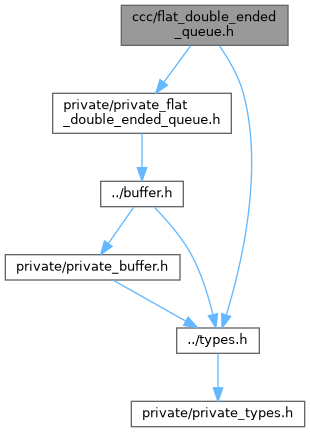
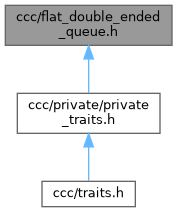
Go to the source code of this file.
Detailed Description
The Flat Double Ended Queue Interface.
An double ended queue offers contiguous storage and random access, push, and pop in constant time. The contiguous nature of the container makes it well-suited to dynamic or fixed size contexts where a double ended queue is needed.
If the container is initialized with allocation permission it will resize when needed but support constant time push and pop to the front and back when resizing is not required, resulting in amortized O(1) operations.
If a double ended queue function requesting an allocator is not provided with one, the behavior is equivalent to a Ring Flat_buffer. This ring buffer behavior is somewhat unique in that it does not fail to insert elements when size is equal to capacity. This means that push front, push back, pop front, and pop back are O(1) operations. However, if any push exceeds capacity an element where the push should occur is overwritten.
To shorten names in the interface, define the following preprocessor directive at the top of your file.
All types and functions can then be written without the CCC_ prefix.
Initialization Interface | |
Initialize and create containers with memory, callbacks, and permissions. | |
| #define | CCC_flat_double_ended_queue_default(type_name) CCC_private_flat_double_ended_queue_default(type_name) |
| Initialize a contiguous empty flat_double_ended_queue of a type. | |
| #define | CCC_flat_double_ended_queue_for( type_name, capacity, count, data_pointer...) |
| Initialize the queue with memory and allocation permission. | |
| #define | CCC_flat_double_ended_queue_from( allocator, optional_capacity, compound_literal_array...) |
| Initialize a Flat_double_ended_queue from a compound literal array initializer. | |
| #define | CCC_flat_double_ended_queue_with_capacity( type_name, allocator, capacity) |
| Initialize a Flat_double_ended_queue with a capacity. | |
| #define | CCC_flat_double_ended_queue_with_storage( count, compound_literal_array...) |
| Initialize the queue from a compound literal array with no allocation permissions or context data. | |
| CCC_Result | CCC_flat_double_ended_queue_copy (CCC_Flat_double_ended_queue *destination, CCC_Flat_double_ended_queue const *source, CCC_Allocator const *allocator) |
| Copy the queue from source to newly initialized destination. | |
| CCC_Result | CCC_flat_double_ended_queue_reserve (CCC_Flat_double_ended_queue *queue, size_t to_add, CCC_Allocator const *allocator) |
| Reserves space for at least to_add more elements. | |
Insert and Remove Interface | |
Add or remove elements from the FDEQ. | |
| #define | CCC_flat_double_ended_queue_emplace_back( flat_double_ended_queue_pointer, allocator_pointer, value...) |
| Write an element directly to the back slot of the flat_double_ended_queue. O(1) if no allocation permission amortized O(1) if allocation permission is given and a resize is required. | |
| #define | CCC_flat_double_ended_queue_emplace_front( flat_double_ended_queue_pointer, allocator_pointer, value...) |
| Write an element directly to the front slot of the flat_double_ended_queue. O(1) if no allocation permission amortized O(1) if allocation permission is given and a resize is required. | |
| void * | CCC_flat_double_ended_queue_push_back (CCC_Flat_double_ended_queue *queue, void const *type, CCC_Allocator const *allocator) |
| Push the user type to the back of the flat_double_ended_queue. O(1) if no allocation permission amortized O(1) if allocation permission is given and a resize is required. | |
| CCC_Result | CCC_flat_double_ended_queue_push_back_range (CCC_Flat_double_ended_queue *queue, CCC_Flat_buffer const *range, CCC_Allocator const *allocator) |
| Push the range of user types to the back of the flat_double_ended_queue. O(N). | |
| void * | CCC_flat_double_ended_queue_push_front (CCC_Flat_double_ended_queue *queue, void const *type, CCC_Allocator const *allocator) |
| Push the user type to the front of the flat_double_ended_queue. O(1) if no allocation permission amortized O(1) if allocation permission is given and a resize is required. | |
| CCC_Result | CCC_flat_double_ended_queue_push_front_range (CCC_Flat_double_ended_queue *queue, CCC_Flat_buffer const *range, CCC_Allocator const *allocator) |
| Push the range of user types to the front of the flat_double_ended_queue. O(N). | |
| void * | CCC_flat_double_ended_queue_insert_range (CCC_Flat_double_ended_queue *queue, void *position, CCC_Flat_buffer const *range, CCC_Allocator const *allocator) |
| Push the range of user types before position of the flat_double_ended_queue. O(N). | |
| CCC_Result | CCC_flat_double_ended_queue_pop_front (CCC_Flat_double_ended_queue *queue) |
| Pop an element from the front of the flat_double_ended_queue. O(1). | |
| CCC_Result | CCC_flat_double_ended_queue_pop_back (CCC_Flat_double_ended_queue *queue) |
| Pop an element from the back of the flat_double_ended_queue. O(1). | |
Container Types | |
Types available in the container interface. | |
| typedef struct CCC_Flat_double_ended_queue | CCC_Flat_double_ended_queue |
| A contiguous Flat_buffer for O(1) push and pop from front and back. | |
Deallocation Interface | |
Destroy the container. | |
| CCC_Result | CCC_flat_double_ended_queue_clear (CCC_Flat_double_ended_queue *queue, CCC_Destructor const *destructor) |
| Set size of queue to 0 and call destructor on each element if needed. O(1) if no destructor is provided, else O(N). | |
| CCC_Result | CCC_flat_double_ended_queue_clear_and_free (CCC_Flat_double_ended_queue *queue, CCC_Destructor const *destructor, CCC_Allocator const *allocator) |
| Set size of queue to 0 and call destructor on each element if needed. Free the underlying Flat_buffer setting the capacity to 0. O(1) if no destructor is provided, else O(N). | |
State Interface | |
Interact with the state of the FDEQ. | |
| void * | CCC_flat_double_ended_queue_begin (CCC_Flat_double_ended_queue const *queue) |
| Return a pointer to the front element of the flat_double_ended_queue. O(1). | |
| void * | CCC_flat_double_ended_queue_reverse_begin (CCC_Flat_double_ended_queue const *queue) |
| Return a pointer to the back element of the flat_double_ended_queue. O(1). | |
| void * | CCC_flat_double_ended_queue_next (CCC_Flat_double_ended_queue const *queue, void const *iterator_pointer) |
| Return the next element in the queue moving front to back. O(1). | |
| void * | CCC_flat_double_ended_queue_reverse_next (CCC_Flat_double_ended_queue const *queue, void const *iterator_pointer) |
| Return the next element in the queue moving back to front. O(1). | |
| void * | CCC_flat_double_ended_queue_end (CCC_Flat_double_ended_queue const *queue) |
| Return a pointer to the end element. It may not be accessed. O(1). | |
| void * | CCC_flat_double_ended_queue_reverse_end (CCC_Flat_double_ended_queue const *queue) |
| Return a pointer to the start element. It may not be accessed. O(1). | |
| void * | CCC_flat_double_ended_queue_at (CCC_Flat_double_ended_queue const *queue, size_t i) |
| Return a reference to the element at index position i. O(1). | |
| void * | CCC_flat_double_ended_queue_front (CCC_Flat_double_ended_queue const *queue) |
| Return a reference to the front of the flat_double_ended_queue. O(1). | |
| void * | CCC_flat_double_ended_queue_back (CCC_Flat_double_ended_queue const *queue) |
| Return a reference to the back of the flat_double_ended_queue. O(1). | |
| CCC_Tribool | CCC_flat_double_ended_queue_is_empty (CCC_Flat_double_ended_queue const *queue) |
| Return true if the size of the queue is 0. O(1). | |
| CCC_Count | CCC_flat_double_ended_queue_count (CCC_Flat_double_ended_queue const *queue) |
| Return the count of active queue slots. O(1). | |
| CCC_Count | CCC_flat_double_ended_queue_capacity (CCC_Flat_double_ended_queue const *queue) |
| Return the capacity representing total possible slots. O(1). | |
| void * | CCC_flat_double_ended_queue_data (CCC_Flat_double_ended_queue const *queue) |
| Return a reference to the base of backing array. O(1). | |
| CCC_Tribool | CCC_flat_double_ended_queue_validate (CCC_Flat_double_ended_queue const *queue) |
| Return true if the internal invariants of the flat_double_ended_queue. | |
Macro Definition Documentation
◆ CCC_flat_double_ended_queue_default
| #define CCC_flat_double_ended_queue_default | ( | type_name | ) | CCC_private_flat_double_ended_queue_default(type_name) |
Initialize a contiguous empty flat_double_ended_queue of a type.
- Parameters
-
[in] type_name the name of the user type in the flat_double_ended_queue.
- Returns
- the initialized flat_double_ended_queue. Directly assign to flat_double_ended_queue on the right hand side of the equality operator.
Initialization of a flat_double_ended_queue can occur at compile time or run time.
The flat_double_ended_queue will be empty with a count and capacity of 0.
◆ CCC_flat_double_ended_queue_emplace_back
| #define CCC_flat_double_ended_queue_emplace_back | ( | flat_double_ended_queue_pointer, | |
| allocator_pointer, | |||
| value... | |||
| ) |
Write an element directly to the back slot of the flat_double_ended_queue. O(1) if no allocation permission amortized O(1) if allocation permission is given and a resize is required.
- Parameters
-
[in] flat_double_ended_queue_pointer a pointer to the flat_double_ended_queue. [in] allocator_pointer a pointer to the CCC_Allocator. [in] value for integral types, the direct value. For structs and unions use compound literal syntax.
- Returns
- a reference to the inserted element. If allocation is permitted and a resizing is required to insert the element but fails, NULL is returned.
◆ CCC_flat_double_ended_queue_emplace_front
| #define CCC_flat_double_ended_queue_emplace_front | ( | flat_double_ended_queue_pointer, | |
| allocator_pointer, | |||
| value... | |||
| ) |
Write an element directly to the front slot of the flat_double_ended_queue. O(1) if no allocation permission amortized O(1) if allocation permission is given and a resize is required.
- Parameters
-
[in] flat_double_ended_queue_pointer a pointer to the queue. [in] allocator_pointer a pointer to the CCC_Allocator. [in] value for integral types, the direct value. For structs and unions use compound literal syntax.
- Returns
- a reference to the inserted element. If allocation is permitted and a resizing is required to insert the element but fails, NULL is returned.
◆ CCC_flat_double_ended_queue_for
| #define CCC_flat_double_ended_queue_for | ( | type_name, | |
| capacity, | |||
| count, | |||
| data_pointer... | |||
| ) |
Initialize the queue with memory and allocation permission.
- Parameters
-
[in] type_name the name of the user type. [in] capacity the number of contiguous elements at data_pointer [in] count the starting size of the flat doubled ended queue. [in] data_pointer a pointer to existing memory or NULL.
- Returns
- the queue on the right hand side of an equality operator at runtime or compiletime (e.g. CCC_Flat_double_ended_queue q = CCC_flat_double_ended_queue_for(...);)
◆ CCC_flat_double_ended_queue_from
| #define CCC_flat_double_ended_queue_from | ( | allocator, | |
| optional_capacity, | |||
| compound_literal_array... | |||
| ) |
Initialize a Flat_double_ended_queue from a compound literal array initializer.
- Parameters
-
[in] allocator the CCC_Allocator needed to copy in the compound literal array elements. [in] optional_capacity optionally specify the capacity of the queue if different from the size of the compound literal array initializer. If the capacity is greater than the size of the compound literal array initializer, it is respected and the capacity is reserved. If the capacity is less than the size of the compound array initializer, the compound literal array initializer size is set as the capacity. Therefore, 0 is valid if one is not concerned with the underlying reservation. [in] compound_literal_array the initializer of the type stored in queue.
- Returns
- the initialized flat_double_ended_queue. Directly assign to queue on the right hand side of the equality operator (e.g. CCC_Flat_double_ended_queue b = CCC_flat_double_ended_queue_from(...);).
Initialize a dynamic Flat_double_ended_queue with a compound literal array.
Initialize a dynamic Flat_double_ended_queue with a compound literal array with capacity.
Only dynamic flat_double_ended_queues may be initialized this way. For static or stack based initialization of fixed flat_double_ended_queues with contents known at compile time, see the CCC_flat_double_ended_queue_with_storage() macro.
◆ CCC_flat_double_ended_queue_with_capacity
| #define CCC_flat_double_ended_queue_with_capacity | ( | type_name, | |
| allocator, | |||
| capacity | |||
| ) |
Initialize a Flat_double_ended_queue with a capacity.
- Parameters
-
[in] type_name any user or language standard type name. [in] allocator the CCC_Allocator for resizing. [in] capacity the capacity of the Flat_double_ended_queue to reserve.
- Returns
- the initialized flat_double_ended_queue. Directly assign to Flat_double_ended_queue on the right hand side of the equality operator (e.g. CCC_Flat_double_ended_queue b = flat_double_ended_queue_with_capacity(...);).
Initialize a dynamic Flat_double_ended_queue.
Only dynamic flat_double_ended_queues may be initialized this way. For static or stack based initialization of fixed flat_double_ended_queues with contents known at compile time, see the CCC_flat_double_ended_queue_with_storage() macro.
◆ CCC_flat_double_ended_queue_with_storage
| #define CCC_flat_double_ended_queue_with_storage | ( | count, | |
| compound_literal_array... | |||
| ) |
Initialize the queue from a compound literal array with no allocation permissions or context data.
- Parameters
-
[in] count the count of elements to start. [in] compound_literal_array the array of user types.
- Returns
- the queue on the right hand side of an equality operator at runtime or compiletime.
Typedef Documentation
◆ CCC_Flat_double_ended_queue
| typedef struct CCC_Flat_double_ended_queue CCC_Flat_double_ended_queue |
A contiguous Flat_buffer for O(1) push and pop from front and back.
- Warning
- it is undefined behavior to use an uninitialized flat double ended queue.
A flat double ended queue can be initialized on the stack, heap, or data segment at compile time or runtime.
Function Documentation
◆ CCC_flat_double_ended_queue_at()
| void * CCC_flat_double_ended_queue_at | ( | CCC_Flat_double_ended_queue const * | queue, |
| size_t | i | ||
| ) |
Return a reference to the element at index position i. O(1).
- Parameters
-
[in] queue a pointer to the flat_double_ended_queue. [in] i the 0 based index in the flat_double_ended_queue.
- Returns
- a reference to the element at i if 0 <= i < capacity.
Note that the front of the queue is considered index 0, so the user need not worry about where the front is for indexing purposes.
◆ CCC_flat_double_ended_queue_back()
| void * CCC_flat_double_ended_queue_back | ( | CCC_Flat_double_ended_queue const * | queue | ) |
Return a reference to the back of the flat_double_ended_queue. O(1).
- Parameters
-
[in] queue a pointer to the flat_double_ended_queue.
- Returns
- a reference to the back element or NULL if queue is NULL or the queue is empty.
◆ CCC_flat_double_ended_queue_begin()
| void * CCC_flat_double_ended_queue_begin | ( | CCC_Flat_double_ended_queue const * | queue | ) |
Return a pointer to the front element of the flat_double_ended_queue. O(1).
- Parameters
-
[in] queue a pointer to the flat_double_ended_queue.
- Returns
- a pointer to the user type at the start of the flat_double_ended_queue. NULL if empty.
◆ CCC_flat_double_ended_queue_capacity()
| CCC_Count CCC_flat_double_ended_queue_capacity | ( | CCC_Flat_double_ended_queue const * | queue | ) |
Return the capacity representing total possible slots. O(1).
- Parameters
-
[in] queue a pointer to the flat_double_ended_queue.
- Returns
- the capacity of the queue or an argument error is set if queue is NULL.
◆ CCC_flat_double_ended_queue_clear()
| CCC_Result CCC_flat_double_ended_queue_clear | ( | CCC_Flat_double_ended_queue * | queue, |
| CCC_Destructor const * | destructor | ||
| ) |
Set size of queue to 0 and call destructor on each element if needed. O(1) if no destructor is provided, else O(N).
- Parameters
-
[in] queue a pointer to the flat_double_ended_queue. [in] destructor the destructor context or &(CCC_Destructor){}.
Note that if destructor is non-empty it will be called on each element in the flat_double_ended_queue. However, the underlying Flat_buffer for the flat_double_ended_queue is not freed. If the destructor is NULL, setting the size to 0 is O(1).
◆ CCC_flat_double_ended_queue_clear_and_free()
| CCC_Result CCC_flat_double_ended_queue_clear_and_free | ( | CCC_Flat_double_ended_queue * | queue, |
| CCC_Destructor const * | destructor, | ||
| CCC_Allocator const * | allocator | ||
| ) |
Set size of queue to 0 and call destructor on each element if needed. Free the underlying Flat_buffer setting the capacity to 0. O(1) if no destructor is provided, else O(N).
- Parameters
-
[in] queue a pointer to the flat_double_ended_queue. [in] destructor the destructor context or &(CCC_Destructor){}. [in] allocator the CCC_Allocator to free memory.
Note that if destructor is non-empty it will be called on each element in the flat_double_ended_queue. After all elements are processed the Flat_buffer is freed and capacity is 0. If destructor is NULL the Flat_buffer is freed directly and capacity is 0.
◆ CCC_flat_double_ended_queue_copy()
| CCC_Result CCC_flat_double_ended_queue_copy | ( | CCC_Flat_double_ended_queue * | destination, |
| CCC_Flat_double_ended_queue const * | source, | ||
| CCC_Allocator const * | allocator | ||
| ) |
Copy the queue from source to newly initialized destination.
- Parameters
-
[in] destination the destination that will copy the source queue. [in] source the source of the flat_double_ended_queue. [in] allocator the allocation context in case resizing of destination is needed.
- Returns
- the result of the copy operation. If the destination capacity is less than the source capacity and no allocation function is provided an input error is returned. If resizing is required and resizing of destination fails a memory error is returned.
- Note
- destination must have capacity greater than or equal to source. If destination capacity is less than source, an allocation function must be provided with the allocate argument.
Note that there are two ways to copy data from source to destination: provide sufficient memory and pass NULL as allocate, or allow the copy function to take care of allocation for the copy.
Manual memory management with no allocation function provided.
The above requires destination capacity be greater than or equal to source capacity. Here is memory management handed over to the copy function.
The above allows destination to have a capacity less than that of the source as long as copy has been provided an allocation function to resize destination. These options allow users to stay consistent across containers with their memory management strategies.
◆ CCC_flat_double_ended_queue_count()
| CCC_Count CCC_flat_double_ended_queue_count | ( | CCC_Flat_double_ended_queue const * | queue | ) |
Return the count of active queue slots. O(1).
- Parameters
-
[in] queue a pointer to the flat_double_ended_queue.
- Returns
- the size of the queue or an argument error is set if flat_double_ended_queue is NULL.
◆ CCC_flat_double_ended_queue_data()
| void * CCC_flat_double_ended_queue_data | ( | CCC_Flat_double_ended_queue const * | queue | ) |
Return a reference to the base of backing array. O(1).
- Parameters
-
[in] queue a pointer to the flat_double_ended_queue.
- Returns
- a reference to the base of the backing array.
- Note
- the reference is to the base of the backing array at index 0 with no consideration to where the front index of the queue may be.
- Warning
- it is the users responsibility to ensure that access to any data is within the capacity of the backing buffer.
This method is exposed for serialization or writing purposes but the base of the array may not point to valid data in terms of organization of the flat_double_ended_queue.
◆ CCC_flat_double_ended_queue_end()
| void * CCC_flat_double_ended_queue_end | ( | CCC_Flat_double_ended_queue const * | queue | ) |
Return a pointer to the end element. It may not be accessed. O(1).
- Parameters
-
[in] queue a pointer to the flat_double_ended_queue.
- Returns
- a pointer to the end sentinel element that may not be accessed.
◆ CCC_flat_double_ended_queue_front()
| void * CCC_flat_double_ended_queue_front | ( | CCC_Flat_double_ended_queue const * | queue | ) |
Return a reference to the front of the flat_double_ended_queue. O(1).
- Parameters
-
[in] queue a pointer to the flat_double_ended_queue.
- Returns
- a reference to the front element or NULL if queue is NULL or the queue is empty.
◆ CCC_flat_double_ended_queue_insert_range()
| void * CCC_flat_double_ended_queue_insert_range | ( | CCC_Flat_double_ended_queue * | queue, |
| void * | position, | ||
| CCC_Flat_buffer const * | range, | ||
| CCC_Allocator const * | allocator | ||
| ) |
Push the range of user types before position of the flat_double_ended_queue. O(N).
- Parameters
-
[in] queue a pointer to the flat_double_ended_queue. [in] position the position in the queue before which to push the range. [in] range the buffer from which count elements are pushed. [in] allocator the CCC_Allocator to use in case of resizing.
- Returns
- a pointer to the start of the inserted range or NULL if a resize was required and could not complete.
Note that if no allocation is permitted the queue behaves as a ring buffer. Therefore, pushing a range that will exceed capacity will overwrite elements at the start of the flat_double_ended_queue.
Pushing a range of elements prioritizes the range and allows the range to overwrite elements instead of pushing those elements over the start of the range. For example, push a range {3,4,5} over a queue with capacity 5 before position with value 6.
Notice that 1 and 2 were NOT moved to overwrite the start of the range, the values 3 and 4. Instead, the value 1 was overwritten and the front of the queue progressed to the next value. The only way the start of a range will be overwritten is if the range itself is too large for the capacity. For example, push a range {0,0,3,3,4,4,5,5} over the same flat_double_ended_queue.
Notice that the start of the range, {0,0,3,...}, is overwritten.
◆ CCC_flat_double_ended_queue_is_empty()
| CCC_Tribool CCC_flat_double_ended_queue_is_empty | ( | CCC_Flat_double_ended_queue const * | queue | ) |
Return true if the size of the queue is 0. O(1).
- Parameters
-
[in] queue a pointer to the flat_double_ended_queue.
- Returns
- true if the size is 0 or false. Error if queue is NULL.
◆ CCC_flat_double_ended_queue_next()
| void * CCC_flat_double_ended_queue_next | ( | CCC_Flat_double_ended_queue const * | queue, |
| void const * | iterator_pointer | ||
| ) |
Return the next element in the queue moving front to back. O(1).
- Parameters
-
[in] queue a pointer to the flat_double_ended_queue. [in] iterator_pointer the current element in the flat_double_ended_queue.
- Returns
- the element following iterator_pointer or NULL if no elements follow.
◆ CCC_flat_double_ended_queue_pop_back()
| CCC_Result CCC_flat_double_ended_queue_pop_back | ( | CCC_Flat_double_ended_queue * | queue | ) |
Pop an element from the back of the flat_double_ended_queue. O(1).
- Parameters
-
[in] queue a pointer to the flat_double_ended_queue.
- Returns
- OK if the pop was successful. If queue is NULL or the flat_double_ended_queue is empty an input error is returned.
◆ CCC_flat_double_ended_queue_pop_front()
| CCC_Result CCC_flat_double_ended_queue_pop_front | ( | CCC_Flat_double_ended_queue * | queue | ) |
Pop an element from the front of the flat_double_ended_queue. O(1).
- Parameters
-
[in] queue a pointer to the flat_double_ended_queue.
- Returns
- ok if the pop was successful. If queue is NULL or the flat_double_ended_queue is empty an input error is returned.
◆ CCC_flat_double_ended_queue_push_back()
| void * CCC_flat_double_ended_queue_push_back | ( | CCC_Flat_double_ended_queue * | queue, |
| void const * | type, | ||
| CCC_Allocator const * | allocator | ||
| ) |
Push the user type to the back of the flat_double_ended_queue. O(1) if no allocation permission amortized O(1) if allocation permission is given and a resize is required.
- Parameters
-
[in] queue a pointer to the flat_double_ended_queue. [in] type a pointer to the user type to insert into the queue. [in] allocator the CCC_Allocator to use in case of resizing.
- Returns
- a reference to the inserted element or NULL upon failure to resize due to exhaustion or an empty allocation context passed in the resizing case.
◆ CCC_flat_double_ended_queue_push_back_range()
| CCC_Result CCC_flat_double_ended_queue_push_back_range | ( | CCC_Flat_double_ended_queue * | queue, |
| CCC_Flat_buffer const * | range, | ||
| CCC_Allocator const * | allocator | ||
| ) |
Push the range of user types to the back of the flat_double_ended_queue. O(N).
- Parameters
-
[in] queue pointer to the flat_double_ended_queue. [in] range the buffer from which count elements are pushed. [in] allocator the CCC_Allocator to use in case of resizing.
- Returns
- ok if insertion was successful. If allocation is permitted and a resize is needed but fails an error is returned. If bad input is provided an input error is returned.
Note that if no allocation is permitted the queue behaves as a ring buffer. Therefore, pushing a range that will exceed capacity will overwrite elements at the beginning of the flat_double_ended_queue.
◆ CCC_flat_double_ended_queue_push_front()
| void * CCC_flat_double_ended_queue_push_front | ( | CCC_Flat_double_ended_queue * | queue, |
| void const * | type, | ||
| CCC_Allocator const * | allocator | ||
| ) |
Push the user type to the front of the flat_double_ended_queue. O(1) if no allocation permission amortized O(1) if allocation permission is given and a resize is required.
- Parameters
-
[in] queue a pointer to the flat_double_ended_queue. [in] type a pointer to the user type to insert into the queue. [in] allocator the CCC_Allocator to use in case of resizing.
- Returns
- a reference to the inserted element.
◆ CCC_flat_double_ended_queue_push_front_range()
| CCC_Result CCC_flat_double_ended_queue_push_front_range | ( | CCC_Flat_double_ended_queue * | queue, |
| CCC_Flat_buffer const * | range, | ||
| CCC_Allocator const * | allocator | ||
| ) |
Push the range of user types to the front of the flat_double_ended_queue. O(N).
- Parameters
-
[in] queue a pointer to the flat_double_ended_queue. [in] range the buffer from which count elements are pushed. [in] allocator the CCC_Allocator to use in case of resizing.
- Returns
- ok if insertion was successful. If allocation is permitted and a resize is needed but fails an error is returned. If bad input is provided an input error is returned.
Note that if no allocation is permitted the queue behaves as a ring buffer. Therefore, pushing a range that will exceed capacity will overwrite elements at the back of the flat_double_ended_queue.
◆ CCC_flat_double_ended_queue_reserve()
| CCC_Result CCC_flat_double_ended_queue_reserve | ( | CCC_Flat_double_ended_queue * | queue, |
| size_t | to_add, | ||
| CCC_Allocator const * | allocator | ||
| ) |
Reserves space for at least to_add more elements.
- Parameters
-
[in] queue a pointer to the flat double ended queue. [in] to_add the number of elements to add to the current size. [in] allocator the CCC_Allocator to use to reserve memory.
- Returns
- the result of the reservation. OK if successful, otherwise an error status is returned.
- Note
- see the CCC_flat_double_ended_queue_clear_and_free_reserve function if this function is being used for a one-time dynamic reservation.
◆ CCC_flat_double_ended_queue_reverse_begin()
| void * CCC_flat_double_ended_queue_reverse_begin | ( | CCC_Flat_double_ended_queue const * | queue | ) |
Return a pointer to the back element of the flat_double_ended_queue. O(1).
- Parameters
-
[in] queue a pointer to the flat_double_ended_queue.
- Returns
- a pointer to the user type at the back of the flat_double_ended_queue. NULL if empty.
◆ CCC_flat_double_ended_queue_reverse_end()
| void * CCC_flat_double_ended_queue_reverse_end | ( | CCC_Flat_double_ended_queue const * | queue | ) |
Return a pointer to the start element. It may not be accessed. O(1).
- Parameters
-
[in] queue a pointer to the flat_double_ended_queue.
- Returns
- a pointer to the start sentinel element that may not be accessed.
◆ CCC_flat_double_ended_queue_reverse_next()
| void * CCC_flat_double_ended_queue_reverse_next | ( | CCC_Flat_double_ended_queue const * | queue, |
| void const * | iterator_pointer | ||
| ) |
Return the next element in the queue moving back to front. O(1).
- Parameters
-
[in] queue a pointer to the flat_double_ended_queue. [in] iterator_pointer the current element in the flat_double_ended_queue.
- Returns
- the element preceding iterator_pointer or NULL if no elements follow.
◆ CCC_flat_double_ended_queue_validate()
| CCC_Tribool CCC_flat_double_ended_queue_validate | ( | CCC_Flat_double_ended_queue const * | queue | ) |
Return true if the internal invariants of the flat_double_ended_queue.
- Parameters
-
[in] queue a pointer to the flat_double_ended_queue.
- Returns
- true if the internal invariants of the queue are held, else false. Error if queue is NULL.
